

Our Newsletter
Stay up to date with news, tips, advice and updates from the community.
Thank you! Your submission has been received.
Oops! Something went wrong while submitting the form.

© Toddlers By Jenna Pty Ltd




Discipline & Boundaries
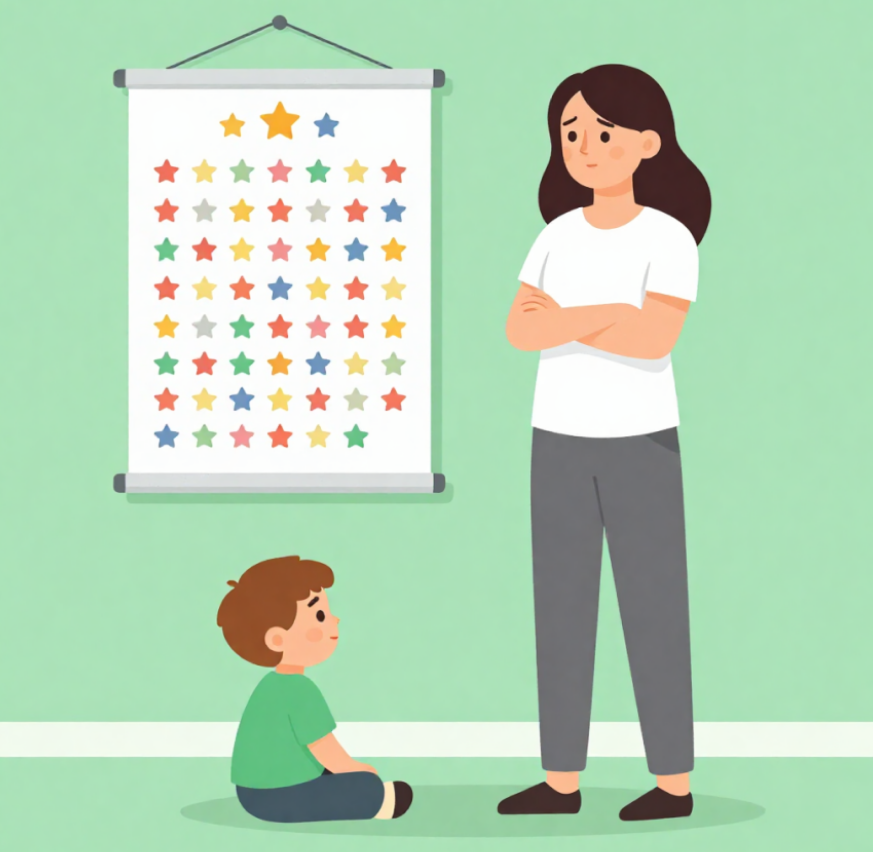
Star charts run on extrinsic motivation, stickers and prizes for good behaviour, and while they feel exciting for the first week, the novelty always wears off, forcing you to keep raising the stakes just to keep the system working. What actually creates lasting behaviour change is intrinsic motivation, and specific, genuine praise delivered in the moment builds that far more effectively than any chart, sticker or prize ever could.
A lot of our generation learned about the power of positive reinforcement when we learned about Pavlov's Dogs and operant conditioning. For some reason this had a huge impact on us, and so we all very naturally are big on praising our kids when they do something right. Plus if you add to this the rise in 'gentle parenting' and a false rumour about never saying 'no' to your kids... it's no wonder our generation lean heavily into positive reinforcement. Enter the start chart!
Parents use star charts for all kinds of reasons - to help with toilet training, to stop unwanted behaviour like hitting siblings or to get your child to be involved in household tasks/ chores.
What a sticker chart is, is extrinsic motivation. This means that the motivation comes from being rewarded through praise, stickers or prizes.
These kinds of positive reinforcement like stickers and prizes work temporarily, but the motivation fades as the novelty wears off, and you find yourself constantly having to raise the stakes to keep the system working. While putting stickers on a chart can be exciting and motivating for the first week, after a while the buzz wares off and then you need to keep changing things up to keep your children motivated.
This is the first reason why I don't recommend start charts for toddlers. It ends up being a lot of work for the parents to uphold the system, remember to reward the desired behaviour every time you see it, and keep the system exciting enough to keep working. Parents already have too much on their plates - they don't need to add to the mental load with a star chart.
The second reason is that children ultimately need to develop internal motivation for their behaviour, not learn to do things only when there is a prize on offer. Especially when it comes to being kind, helping around the house, not hurting others, we want our children to authentically behave well rather than doing these things in a superficial way only to receive the reward.
While you might see short term success using rewards for good behaviour, this likely won't translate to other environments or over a long stretch of time as your toddler will be less likely to behave well if you're not constantly monitoring them.
For toilet training consistently (I know star charts are used a lot when teaching toddlers to use the toilet), the natural intrinsic reward is the feeling of your body being comfortable and having done it's job. This is all a toddler needs to accomplish the job in a way that won't create problems down the line.
What does work is specific, genuine positive feedback in the moment. "I noticed how quickly you came to the bath when I asked tonight" or "Wow! You put your clothes in the washing basket without me even reminding you!"
This tells your child precisely what they did well, builds their self-image in a positive direction and reinforces the behaviour you want to see, without any charts, stickers or prizes required. Just naturally noticing what your child is doing well.
For more help, browse my discipline guides, or book a 1:1 consult.
Stay up to date with news, tips, advice and updates from the community.