

Our Newsletter
Stay up to date with news, tips, advice and updates from the community.
Thank you! Your submission has been received.
Oops! Something went wrong while submitting the form.

© Toddlers By Jenna Pty Ltd


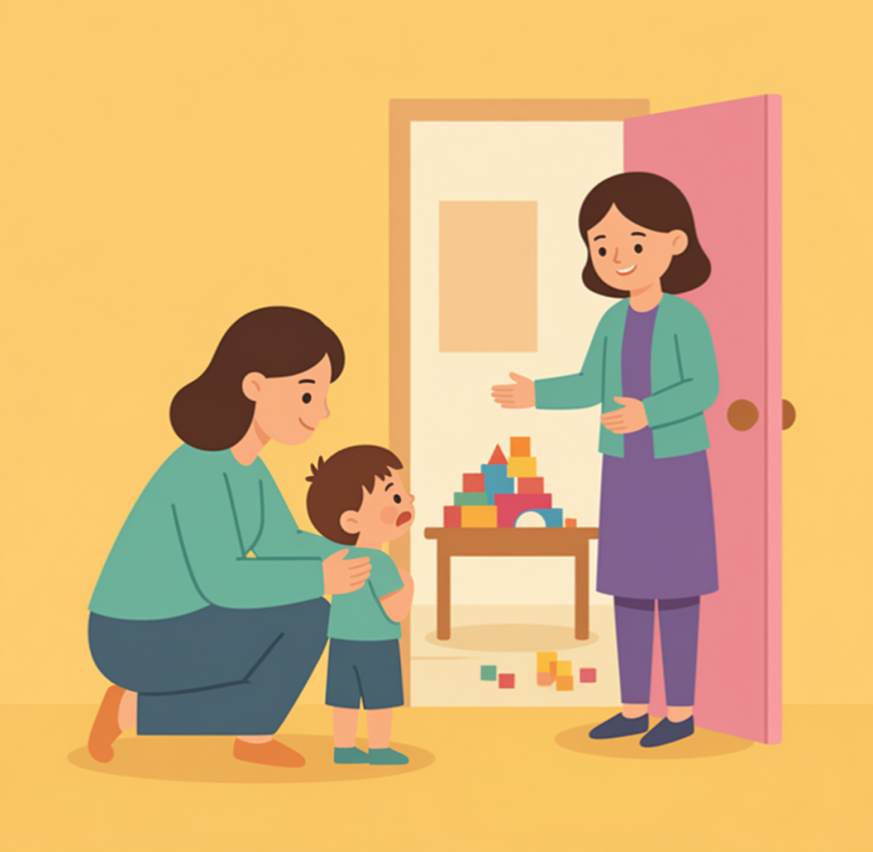


Separation Anxiety
If you have ever peeled a sobbing toddler off your leg at the daycare door, watched their face crumple as you reach for your keys, or felt that familiar lump in your own throat as you walk away, I want to say something to you right at the start: this is not a behavior problem, and your child is not being manipulative.
Separation anxiety is one of the healthiest, most primal signs of a working relationship between you and your child. It is the visible proof that you matter enormously to them, and that the attachment you have built is doing exactly what it is supposed to do.
Let's slow down and really understand what is happening, because when you understand the "why," the hard mornings start to feel less like a battle and more like a season you are walking your child through.
Separation anxiety is the distress a baby or toddler feels when they are apart from the person (or people) they are most attached to. It is not a character flaw, a bad habit, or evidence that you have done something wrong in raising your child. It is a developmental milestone, as expected as rolling over or saying first words.
There is a cognitive piece underneath all of this. Around 6 to 9 months, babies develop what psychologists call object permanence, the understanding that things and people still exist even when they cannot be seen. This is a leap forward in the brain, but it comes with a catch: now your baby knows you still exist somewhere when you walk out of the room, but they do not yet understand when or whether you are coming back. That gap, between knowing you exist and trusting you will return, is the emotional space where separation anxiety lives.
To really understand separation anxiety, we have to go back to the people who first explained it.
John Bowlby, a British psychiatrist working in the mid-twentieth century, proposed that babies are biologically wired to form attachments to their caregivers. This is not learned behavior or a side effect of being fed; it is an evolved survival system. Bowlby argued that the attachment bond exists, at its root, to keep a vulnerable infant close to a protective adult and therefore alive. Crying, clinging, reaching, and searching are not "naughty." They are what Bowlby called attachment behaviors, and they switch on automatically when a child feels distance or threat. Bowlby framed separation distress as a normal, adaptive response in a securely attached child.
Bowlby gave us the phrase that still anchors everything we understand about this: the secure base. A child uses their trusted caregiver as a secure base from which to explore the world and as a safe haven to return to for comfort. Picture a toddler at a playground. They toddle off to investigate the slide, then glance back at you, then go a little further, then run back to bury their face in your knees, then set off again. That loop, venturing out and checking back, is the secure base in action. The child can only explore as far as they feel safe. You are the home base that makes the adventure possible.
Bowlby's collaborator, the American-Canadian psychologist Mary Ainsworth, took these ideas and made them measurable. In the 1970s she designed the famous "Strange Situation" procedure, where a toddler explores with the parent present, the parent leaves, a stranger is present, the parent returns, and researchers watch carefully, especially during the reunions.
What Ainsworth found is profoundly reassuring for parents of criers. The defining feature of security is not the absence of distress. A securely attached child often becomes visibly upset when the parent leaves. What marks security is what happens at reunion: the child seeks out the parent, is comforted relatively quickly, and then returns to play. In other words, being upset that you left and being soothed when you return is the textbook picture of healthy attachment. The crying is not the problem. The crying, followed by comfort and recovery, is the system working.
Ainsworth is also credited with formalizing the concept of caregiver sensitivity, the idea that warm, consistent, attuned responses to a child's signals are what build secure attachment over time. This matters for daycare too, as we will see.
So why would evolution build in something that makes everyone cry at the door? Because for almost all of human history, a small child who wandered away from their caregivers, or who felt no distress at being left with strangers, was a child in danger.
Separation anxiety is the emotional alarm system that kept our ancestors' children close and safe.
Here is the reframe I want you to hold onto: every time your toddler protests being left, they are telling you that you are their person, their safe place, their secure base. The intensity of the protest is, in a real sense, a measure of the strength of the bond. That is not a burden.
That is a love letter, written in the only language a toddler has. That's not to say that there is something wrong with your relationship if your child walks off into their teachers arms without shedding a tear. Some child have a harder or louder time with goodbyes than others. And sometimes they take turns having a hard time... some during the earlier toddler years, and others later on.
Toddlerhood adds a special twist that infancy does not have. The toddler is no longer a baby who simply wants to be held. They are a brand-new person discovering will, opinions, and the thrilling, terrifying power of "I can do it myself."
The child psychologist Alicia Lieberman, writes that toddlerhood, "perhaps more dramatically than any other age," brings us "face to face with two powerful yet contradictory impulses: the longing to feel safe in the protective sphere of intimate relationships and the exhilarating thrust of carefree, unrestricted, uninhibited exploration, where one can soar free without looking back at those who are left behind."
That is the toddler's daily, exhausting reality. They genuinely want both at once: to march boldly into the daycare classroom AND to stay glued to you forever.
Lieberman illustrates the contradiction with an image any parent will recognize: the crying toddler "who runs to his mother for a hug only to push himself vigorously away as soon as she begins to embrace him." They do not know what they want, because they want opposite things with equal force. Daycare drop-off is simply the place where that internal tug-of-war becomes most visible.
If you have more than one child, or if you have ever compared notes with another parent, you already know that separation anxiety does not look the same on every kid. Some scream. Some go silent. Some seem fine for weeks and then fall apart. This is largely about temperament, the inborn emotional style a child brings into the world.
The Harvard developmental psychologist Jerome Kagan spent decades studying this. He identified a few different categories of temperament which all affected how a child reacted to being separated from their parents. Kagan even tracked biological markers like heart rate and found these styles were stable and partly built in, not created by parenting. A high-reactive, behaviorally inhibited toddler is not anxious because you did something wrong. They came pre-tuned to find new situations harder, and daycare is about as novel as a situation gets.
This is why I describe such different children in my own work. Consider three composite toddlers I often think about:
None of these children is doing it "right" or "wrong." They are three different nervous systems metabolizing the same big experience at their own pace.
Here is something I wish every parent knew: crying at drop-off is the most obvious sign of separation stress, but it is far from the only one. Many toddlers, especially the quiet copers and the delayed reactors, express their stress in ways that are easy to miss or to misread as "bad behavior." When you know what to look for, you can respond with compassion instead of correction.
Watch for signs like these, and notice that each one makes sense once you see it as stress, not defiance:
One of the most confusing things for parents is when a child who settled beautifully suddenly struggles again, three months into the school year, or after a great patch. You did nothing wrong. Resurgence is normal and expected.
There are many seemingly unrelated triggers that can cause an uptick in separation anxiety - a new childcare situation or caregiver, a new sibling, moving to a new house, parents travelling, tension at home, potty training, moving to a toddler bed, illness and recovery, travel that upends routine, and ordinary developmental leaps. Whenever the rest of a toddler's world feels unfamiliar, they cling harder to the one constant they trust most: you.
This is why "Sophie," who seemed unaffected for months, eventually struggled. Sometimes the anxiety was never absent; it was just delayed until she felt safe enough to feel it, or until some small change tipped the balance.
It is worth naming clearly: separation anxiety is not only a daycare phenomenon. Saying goodnight is also a separation, and the same dynamics apply. Your child understands you come back in the morning, the same way they learn you come back at pickup, but the goodbye still stings.
Bedtime resistance, wanting you to stay in the room, and night waking often spike during the same periods as daycare struggles, for the same underlying reason. Separation anxiety that resurfaces around age two means a toddler "may struggle more with saying goodnight and being alone," which "can affect bedtime and sleep, leading to bedtime stalling or overnight wakes." If you see daycare and bedtime struggles together, you are not dealing with two problems. You are dealing with one attachment system expressing itself in two settings.
I want to hold two truths at once. The first is that the overwhelming majority of separation anxiety is completely normal and resolves with time, consistency, and warmth. The second is that, occasionally, anxiety crosses into territory where professional support helps, and knowing the line lets you relax about everything on the normal side of it.
Separation anxiety is the price of a beautiful thing. It exists because you built a secure base so solid that your child does not want to leave it. The work ahead is not to make your child stop needing you. It is to help them carry the felt sense of you with them, so that the secure base lives inside them even when you are at work. That is the project of the next two articles. For now, breathe, and remember: those tears are the sound of love working exactly as designed.
Stay up to date with news, tips, advice and updates from the community.