
Our Newsletter
Stay up to date with news, tips, advice and updates from the community.
Thank you! Your submission has been received.
Oops! Something went wrong while submitting the form.

© Toddlers By Jenna Pty Ltd



Playtime
Turning play into a lesson, naming colours, quizzing shapes, counting out loud, feels productive, but it pulls your toddler out of their own focus and into performing for you. At this age, play IS the lesson: in problem solving, emotional regulation, and making sense of the world. What your toddler actually needs is open-ended toys, uninterrupted time, and a parent who's present without directing.
"What colour is that block?" "Can you count them with me?" "Look, this one's a triangle!" If you've ever found yourself narrating a toddler's play like a walking flashcard, you're not alone, and you're not doing anything wrong either.
Most of us grew up believing that play is only valuable if it's teaching something measurable. But when it comes to toddlers, that instinct is doing far less good than it feels like it should, and it's often getting in the way of something much more important.
It makes sense that parents gravitate toward this. Toys are marketed as educational. Apps promise early literacy.
Even a simple stacking cup set on the shelf might have letters printed on it somewhere. There's a quiet pressure to make every moment count, to turn play into a stepping stone toward some future academic milestone, as if unstructured play is time wasted.
Our generation are focused on maximising every moment, bring productive and getting ahead. God forbid our children should play just for plays sake without 'learning' something.
But toddlers aren't small students waiting to be taught colours and shapes. They're in the middle of the most important developmental work of their lives, and it has almost nothing to do with academics. They are using play to figure out who they are and how the world works. And they can do this by themselves without any formal instruction at all.
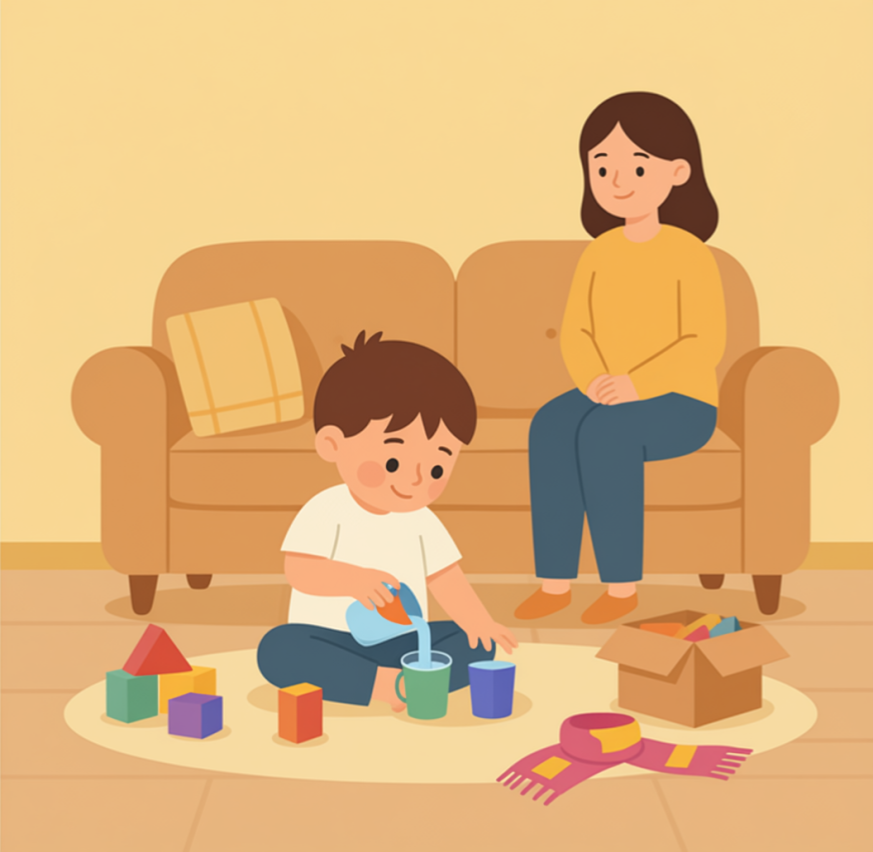
At two and three years old, play is the primary way your toddler processes their world, works through big feelings, and builds the neural pathways for problem solving, focus, and emotional regulation. When a toddler lines up cars over and over, or spends twenty minutes filling and dumping a container of water, they aren't wasting time between "real" learning moments. That repetition, that total absorption, is the learning.
Play is also how toddlers process the things they don't have words for yet: a new sibling, a scary trip to the doctor, a big change at home.
You'll often see this show up as pretend play around themes that seem oddly specific or even a little dark, playing doctor, pretending to go on a plane after a house move, "killing" a toy after a stressful event. This isn't something to redirect away from. It's your toddler working something out, in the only language available to them at this age.
When we jump in with "what colour is this" or "can you count to five," we're pulling our toddler out of their own internal process and redirecting their attention toward performing for us. Over time, this can actually shorten attention span rather than build it, since the toddler learns that play means waiting for the next prompt rather than following their own curiosity.
It also sends a subtle message that play alone isn't enough, that it only counts once an adult has turned it into a lesson. That's the opposite of what actually builds confidence and independent thinking. A toddler who's left to figure out why the block tower keeps falling, without a parent jumping in to explain "it's because it's not balanced," is doing far more valuable cognitive work than one who's handed the answer.
Open-ended toys, not "answer" toys. Blocks, dress-ups, a cardboard box, a set of scarves, a doll and a blanket. These have no single "right" way to play, and they let your toddler direct their own experience rather than fitting themselves to a predetermined outcome.
A toy that only does one thing (press the button, the same light and sound every time) runs out of learning potential quickly. A toy with no fixed purpose can be reinvented endlessly.
Time to be bored. Boredom isn't a problem to solve. It's often the doorway to your toddler's most creative and independent play, the moment right before they invent a game entirely on their own. Rescuing them from every dull stretch with a new activity or a screen removes the very discomfort that builds their own capacity to self-direct.
Uninterrupted stretches, even short ones. Constant check-ins, suggestions, and questions fragment a toddler's play before it has a chance to deepen. Where you can, let a stretch of play run without stepping in, even five or ten minutes of true, uninterrupted play is often enough for a toddler to fully settle into what they're doing.
Parents worry about their child not having a long attention span, but if you observe them at play; their parent is often unintentionally interrupting them with comments, questions or suggestions. Just observe from a distance and use it as an opportunity for you to be learning about your child, rather than your child learning from you.
Permission for play to look "pointless." Filling and emptying a cup. Pushing a truck back and forth along the same path. Carrying every stuffed animal in the house to one corner of the room.
None of this needs a lesson attached to make it worthwhile. The repetition and the absorption are doing the work. Children are natural explorers and scientists. They have a natural capacity to use play to test out hypothesis, play out ideas in their mind or invent totally novel schemas.
When we try to teach them to play 'the right way' with a toy, we interrupt this beautiful, natural process. What looks pointless and 'wrong' to you, is extremely meaningful and productive for your child.
A parent who's present without directing. You don't need to disappear from play entirely, being nearby, available, and interested is valuable. The shift is simply from directing ("this is a circle, can you say circle?") to following ("I see you're stacking those really high"), and stepping back the moment your toddler is absorbed on their own.
Play belongs to children. This means that they should be leading their play 100% and allowing it to take them where they wish (so long as they're being safe). When parents interfere with their child's play by showing them the 'right way' to play with something or asking them questions, it takes the power out of your child's hands and shifts the focus of the play to your desires rather than theirs.
Next time you catch yourself about to jump into your toddler's play with a question or a fact, try pausing for a moment first.
Ask yourself: is this actually adding something, or am I interrupting something that was already working? More often than not, the most useful thing you can do is nothing at all, just stay close, stay interested, and let your toddler lead. To watch your toddler focused and in the flow of play is a truly remarkable thing to witness - sit back and enjoy it.
Play doesn't need to be turned into a lesson to be valuable.
For a toddler, play is the lesson, in emotional regulation, problem solving, focus, and making sense of their world. The most powerful thing you can offer isn't a running commentary of colours and counting. It's space, time, and the quiet trust that your toddler already knows exactly what they need to work through, one block tower, one poured cup of water, at a time.
For more on getting play right, browse my playtime guides, or book a 1:1 consult.
Stay up to date with news, tips, advice and updates from the community.