

Our Newsletter
Stay up to date with news, tips, advice and updates from the community.
Thank you! Your submission has been received.
Oops! Something went wrong while submitting the form.

© Toddlers By Jenna Pty Ltd




Playtime
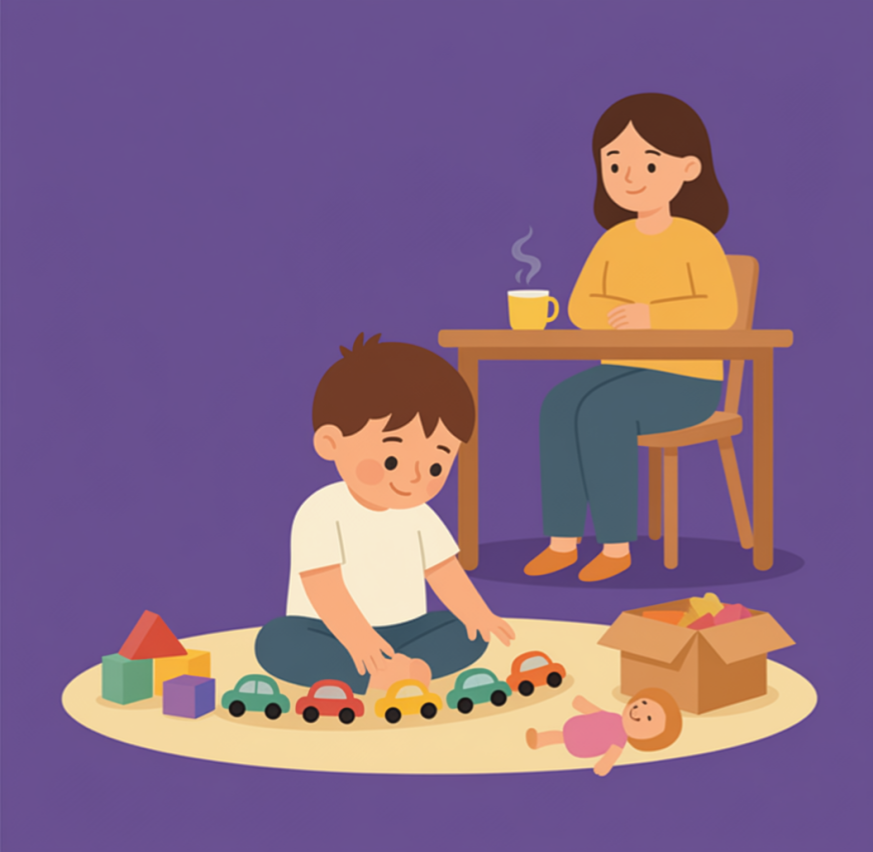
Most play mistakes aren't about doing something dramatically wrong, they're subtle habits like turning play into a lesson, rescuing your toddler from boredom, or over-praising what they make. These well-intentioned habits quietly work against the focus, creativity, and independence you're trying to build. Fixing them is less about managing play more closely and more about stepping back.
Most parents want their toddler to play well, to be curious, focused, and able to entertain themselves for more than ninety seconds at a time. But a lot of the everyday habits we bring to play, often with the best intentions, quietly work against exactly that. Here are the mistakes I see most often, and what to do instead.
Constantly naming colours, counting objects, or asking quiz-style questions during play ("what shape is that?") feels productive, but it pulls your toddler out of their own focus and into performing for you. Play is already the lesson at this age, in problem solving, attention, and emotional processing. It doesn't need a running commentary layered on top to be worthwhile.
If you catch yourself narrating constantly, try simply describing what you observe instead of quizzing: "you're stacking those so high," rather than "how many blocks is that?". Switch your role from 'teacher' to 'observer' and watch how much shifts.
The instinct to jump in the moment your toddler says "I'm bored" or starts wandering aimlessly is a strong one, but constantly filling that gap with a new activity, a suggestion, or a screen removes the exact discomfort that leads to your toddler inventing their own game. Boredom is often the doorway to the most independent, creative play you'll see from them. Sitting with a few minutes of restless nothing, without immediately solving it for them, is doing them a favour, even though it doesn't always feel like it in the moment.
A room full of toys doesn't produce more play, it usually produces more chaos and shorter attention spans. When everything is visible and available all the time, a toddler flits from one thing to the next without settling into any of it. Keeping a smaller selection out at any given time (and storing the rest away) tends to lead to deeper, longer, more focused play with whatever is available.
Toys with a single fixed function (press the button, hear the same three sounds, watch the same lights) run out of play value fast, because there's nothing left to explore once the novelty wears off. Open-ended toys, blocks, dolls, a simple kitchen set, scarves, a cardboard box, keep offering something new because your toddler decides what they become. If you're choosing between two toys, the one with fewer "instructions" built in is almost always the better bet.
Constant check-ins, correcting how a toy is "supposed" to be used, or redirecting play toward something more productive-looking all fragment your toddler's focus before it has a chance to deepen. If your toddler is safely absorbed in something, even if it looks repetitive or purposeless to you, it's usually worth staying out of it rather than stepping in to shape it.
Play is where children learn resilience, persistance and problem solving. When you jump in to help them or correct what they're doing, you're robbing them of the opportunity to develop these skills. Remember there is no right way to play (even a puzzle doesn't need to be done 'right' if your child is in the process of figuring it out) so back off even if your child is using a toy the wrong way.
Big reactions to a finished puzzle or a "good" drawing can unintentionally shift play from something a toddler does for its own sake into something done for your approval. Over time, this can make a toddler more focused on your reaction than on their own experience of the play itself. A simple, neutral acknowledgment ("you worked hard on that") holds up better than an enthusiastic ovation every time.
Filling and dumping the same cup of water forty times. Carrying every soft toy in the house to one corner of the room. Lining up cars in a row and doing it again the second they're disturbed.
These repetitive, seemingly pointless activities are often exactly where the real developmental work is happening, in focus, sequencing, and self-soothing. Rushing to tidy up, redirect, or move a toddler along from this kind of play removes something valuable, even though it can look unproductive from the outside.
Back-to-back activities, classes, and outings leave very little unstructured time for a toddler to actually sink into their own play. Down time isn't wasted time. It's often the only space in a toddler's day where they get to lead rather than follow, and that matters for building independence and creativity.
When a toddler's pretend play touches on something that feels heavy, playing doctor, pretending someone died, re-enacting a scary moment, the instinct is often to redirect them toward something lighter. But this kind of play is frequently how toddlers process real events and big feelings they don't yet have words for. Unless it's genuinely distressing to them, it's usually better to let it unfold rather than steer it away.
Independent play is a skill that's built gradually, through short, repeated stretches of a parent being nearby but not engaged, rather than something a toddler can simply do on command. If the first attempt is met with protest and a parent gives up and jumps back in every time, the toddler never gets the chance to develop the tolerance for it. Building it slowly, starting with just a minute or two of a parent being "busy" nearby, tends to work far better than an all-or-nothing approach.
Don't be afraid to set a boundary around whether you'll play with your toddler or not. It's perfectly acceptable to say "I'm busy cleaning up the kitchen, why don't you get started and I'll come and check in when I'm done"
It's an easy trap: a birthday or holiday brings a flood of new toys, and it feels like generosity. But a toddler overwhelmed with options often engages with none of them deeply. Fewer, better chosen toys, rotated over time, consistently produce richer play than a room stuffed with everything at once.
Also if you're thinking "hrmm my toddler isn't really engaging much and struggling to play alone, maybe a new toy will do the trick"... stop! New toys will be shiny and exciting for a few hours, but without the skills to initiate play and keep it going, no amount of new toys will help.
Every toddler engages with play differently, some are drawn to building, others to pretend play, others to repetitive sensory activities like water or sand. Worrying that your toddler "should" be doing a more advanced or more social kind of play, based on what another child their age is doing, tends to create pressure that gets in the way of them following their own genuine interest.
Most of these mistakes come from a good place: wanting to make the most of playtime, wanting to see visible progress, wanting to keep a toddler entertained and stimulated. But the thing that actually builds focus, creativity, and independence in play is largely the opposite of managing it more closely. It's stepping back, offering the right kind of toys and enough unstructured time, and trusting your toddler to do the rest.
For more on getting play right, browse my playtime guides, or book a 1:1 consult.
Stay up to date with news, tips, advice and updates from the community.